
Wrench Sizes in Order Standard
Fractions make SAE wrench sizes hard to put in order — is 19/32 bigger than 5/8? This page lists standard SAE and metric wrench sizes from smallest to largest with their decimal and millimetre equivalents, sorts any list of sizes you paste in, finds the closest substitute between systems, and tells you which wrench fits a given bolt.
- Free to use
- No sign-up
- Runs in your browser
Wrench size sorter and converter
All standard sizes in order
Wrench Size Chart Pack
Printable wrench size charts: SAE and metric sizes in order with mm equivalents, bolt-to-wrench charts (inch, ISO, DIN, JIS) and a tool inventory sheet.
- Sizes in order (PDF/XLSX)
- Inch bolt chart (PDF)
- Metric bolt chart (PDF)
- Tool inventory (PDF/DOCX/XLSX)
Formats: PDF, XLSX, DOCX. Instant download after payment (link valid 72 hours, up to 5 downloads). AI-assisted: the templates were drafted with AI help and reviewed and laid out before publishing.
$5.00 USD, one-time 4 files · about $1.25 each
- Instant download
- 7-day refund
- Secure checkout by Stripe
7-day money-back guarantee. Full refund within 7 days of purchase, even after you download.
Free sample: Bolt to Wrench Inch (PDF, 52 KB)
Full refund within 7 days — see the refund policy and license.
Free printables
Single sheets you can print right now, no sign-up. The full pack adds every sheet in one download plus the editable files.
 Printable Wrench Size Inventory Sheet
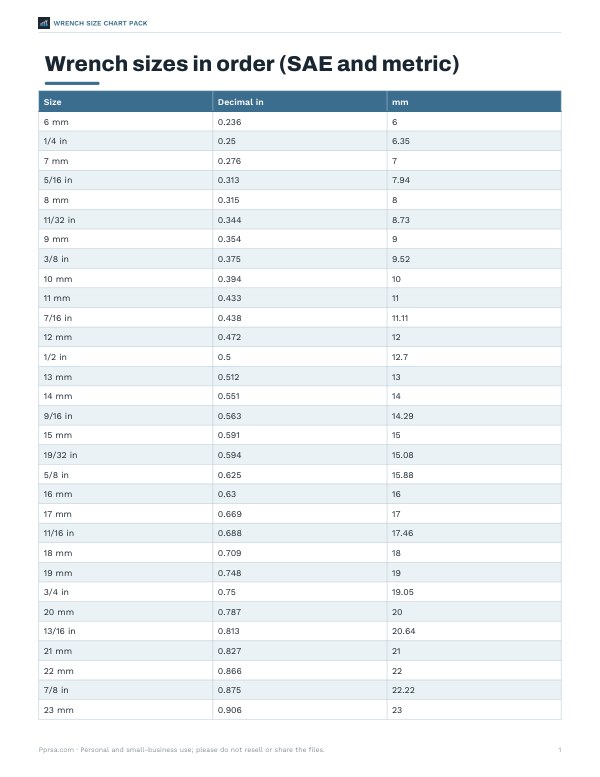
SAE wrench sizes in order
| Size | Decimal (in) | mm |
|---|---|---|
| 1/4 in | 0.2500 | 6.35 |
| 5/16 in | 0.3125 | 7.94 |
| 11/32 in | 0.3438 | 8.73 |
| 3/8 in | 0.3750 | 9.52 |
| 7/16 in | 0.4375 | 11.11 |
| 1/2 in | 0.5000 | 12.70 |
| 9/16 in | 0.5625 | 14.29 |
| 19/32 in | 0.5938 | 15.08 |
| 5/8 in | 0.6250 | 15.88 |
| 11/16 in | 0.6875 | 17.46 |
| 3/4 in | 0.7500 | 19.05 |
| 13/16 in | 0.8125 | 20.64 |
| 7/8 in | 0.8750 | 22.22 |
| 15/16 in | 0.9375 | 23.81 |
| 1 in | 1.0000 | 25.40 |
| 1-1/16 in | 1.0625 | 26.99 |
| 1-1/8 in | 1.1250 | 28.57 |
| 1-3/16 in | 1.1875 | 30.16 |
| 1-1/4 in | 1.2500 | 31.75 |
| 1-5/16 in | 1.3125 | 33.34 |
| 1-3/8 in | 1.3750 | 34.92 |
| 1-7/16 in | 1.4375 | 36.51 |
| 1-1/2 in | 1.5000 | 38.10 |
The easiest way to order fractions is to convert them to a common denominator: in 32nds, 1/4 = 8/32, 5/16 = 10/32, 11/32, 3/8 = 12/32, 7/16 = 14/32, 1/2 = 16/32, 9/16 = 18/32, 19/32, 5/8 = 20/32 and so on. Sizes in 32nds, like 11/32 and 19/32, are less common and not included in every set.
Metric wrench sizes in order
Metric wrenches go up in whole millimetres: 6, 7, 8, 9, 10, 11, 12, 13, 14, 15, 16, 17, 18, 19, 20, 21, 22, 24, 27, 30 and 32 mm are the sizes found in most sets. The most used sizes on cars and bikes are 8, 10, 12, 13, 14, 15, 17 and 19 mm — the 10 mm is famous for going missing. Larger sizes (23, 25, 26, 28 mm and above) are usually bought individually.
SAE and metric equivalents
| SAE | mm | Closest metric | Difference |
|---|---|---|---|
| 1/4 in | 6.35 | 6 mm | metric 0.35 mm smaller |
| 5/16 in | 7.94 | 8 mm | 0.06 mm — interchangeable |
| 3/8 in | 9.53 | 10 mm | 0.47 mm larger — loose |
| 7/16 in | 11.11 | 11 mm | metric 0.11 mm smaller — often fits (wrench openings have clearance) |
| 1/2 in | 12.70 | 13 mm | 0.30 mm larger — slightly loose |
| 9/16 in | 14.29 | 14 mm | metric too small; 15 mm is loose |
| 5/8 in | 15.88 | 16 mm | 0.12 mm — interchangeable in practice |
| 3/4 in | 19.05 | 19 mm | 0.05 mm — interchangeable |
| 7/8 in | 22.23 | 22 mm | metric 0.23 mm smaller — may not fit |
| 15/16 in | 23.81 | 24 mm | 0.19 mm — close |
| 1-1/16 in | 26.99 | 27 mm | interchangeable |
A wrench slightly larger than the fastener will usually fit but can round the corners under high torque, especially with open-end wrenches. Use the correct system whenever possible; six-point sockets and box-end wrenches grip better than twelve-point and open-end tools on tight fasteners.
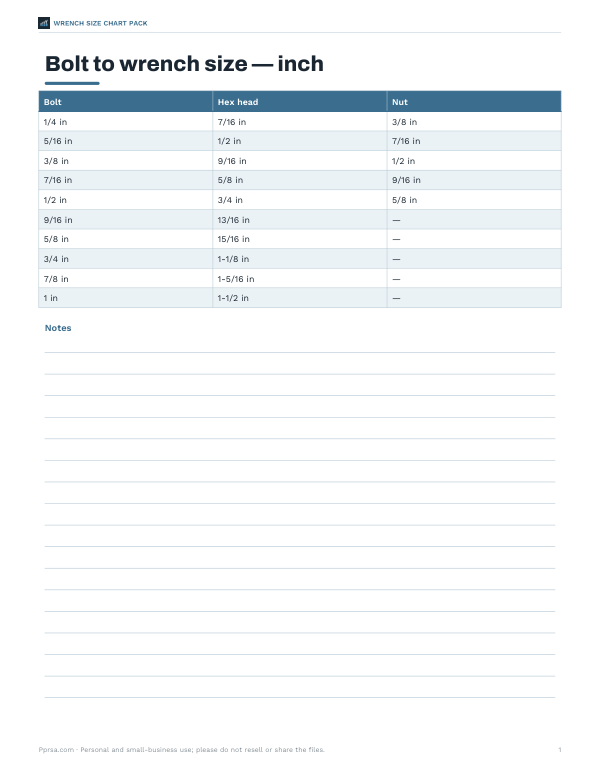
Which wrench fits which bolt (inch)
| Bolt diameter | Hex head wrench | Nut (if different, heavy hex varies) |
|---|---|---|
| 1/4 in | 7/16 in | 3/8 in |
| 5/16 in | 1/2 in | 7/16 in |
| 3/8 in | 9/16 in | 1/2 in |
| 7/16 in | 5/8 in | 9/16 in |
| 1/2 in | 3/4 in | 5/8 in |
| 9/16 in | 13/16 in | — |
| 5/8 in | 15/16 in | — |
| 3/4 in | 1-1/8 in | — |
| 7/8 in | 1-5/16 in | — |
| 1 in | 1-1/2 in | — |
These are standard hex cap screw head sizes; heavy hex bolts and nuts are larger. For machine screws and small bolts, check the actual head, as sizes vary.
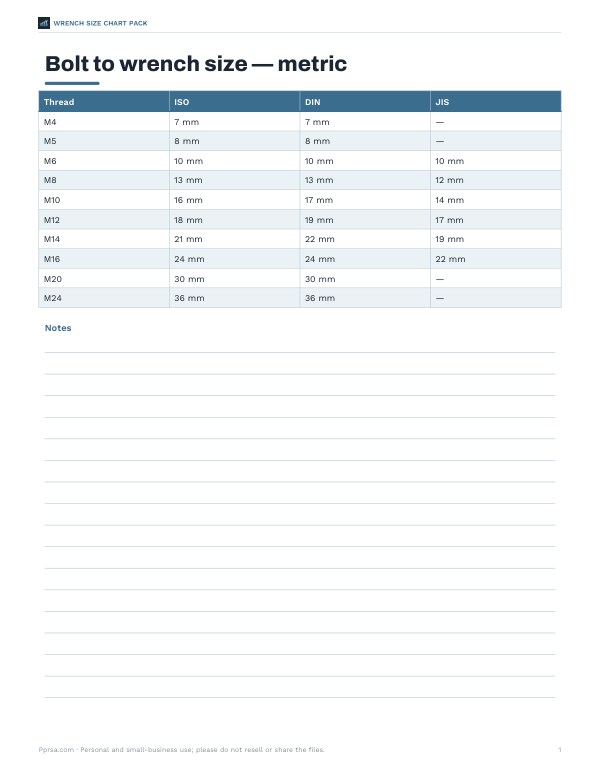
Which wrench fits which bolt (metric)
| Thread | ISO 4017 head | DIN 933 head | JIS (common Japanese) |
|---|---|---|---|
| M4 | 7 mm | 7 mm | — |
| M5 | 8 mm | 8 mm | — |
| M6 | 10 mm | 10 mm | 10 mm |
| M8 | 13 mm | 13 mm | 12 mm |
| M10 | 16 mm | 17 mm | 14 mm |
| M12 | 18 mm | 19 mm | 17 mm |
| M14 | 21 mm | 22 mm | 19 mm |
| M16 | 24 mm | 24 mm | 22 mm |
| M20 | 30 mm | 30 mm | — |
| M24 | 36 mm | 36 mm | — |
The difference between ISO and older DIN standards catches people out: an M10 bolt may have a 16 mm head (ISO) or a 17 mm head (DIN), and an M12 bolt 18 mm or 19 mm. Japanese vehicles often use the smaller JIS head sizes, such as 12 mm for M8, 14 mm for M10 and 17 mm for M12.
Worked example
A drawer of loose wrenches includes 3/4, 5/8, 11/16, 13 mm, 1/2, 9/16, 19/32, 7/16, 17 mm, 10 mm and 3/8. Converted to millimetres and sorted, they run 3/8 (9.53 mm) < 10 mm < 7/16 (11.11) < 1/2 (12.70) < 13 mm < 9/16 (14.29) < 19/32 (15.08) < 5/8 (15.88) < 17 mm (17.00) < 11/16 (17.46) < 3/4 (19.05). Note how 17 mm slips in between 5/8 and 11/16 — exactly the kind of placement that makes mixed drawers confusing, and what the sorter works out for you.
Organising a wrench set
- Hang wrenches on a rail in size order, SAE and metric on separate rails or colour-coded.
- Use foam drawer inserts with cut-outs so a missing wrench is obvious.
- Mark sizes with paint pen on well-worn wrenches where the stamping has faded.
- Keep the most-used sizes — often 10, 13, 17 mm and 1/2, 9/16 in — in a small separate roll for quick jobs.
Wrench types
| Type | Best for |
|---|---|
| Combination | Open end one side, box end the other; the everyday wrench |
| Ratcheting combination | Fast work in tight spaces |
| Flare nut (line) | Brake and fuel line fittings — grips five sides |
| Adjustable | Occasional use and odd sizes; can slip |
| Socket and ratchet | Most mechanical work; sized the same way as wrenches |
| Hex key (Allen) | Hex socket screws — sized separately (1.5–10 mm, 1/16–3/8 in) |
Frequently asked questions
What are the standard SAE wrench sizes in order?
1/4, 5/16, 11/32, 3/8, 7/16, 1/2, 9/16, 19/32, 5/8, 11/16, 3/4, 13/16, 7/8, 15/16, 1 inch and up.
Is 13 mm the same as 1/2 inch?
Close — 1/2 inch is 12.7 mm, so a 13 mm wrench fits a 1/2 inch nut slightly loosely.
What size wrench for an M8 bolt?
13 mm for ISO and DIN heads; 12 mm on many Japanese (JIS) fasteners.
What size wrench for a 3/8 bolt?
9/16 inch for a standard hex cap screw.
Which is bigger, 19/32 or 5/8?
5/8 (20/32) is bigger than 19/32.
Can I use metric wrenches on SAE bolts?
Some pairs are nearly identical (5/16 and 8 mm, 3/4 and 19 mm); others are loose and can round the bolt.